
CrossFitting with injury: stupid or just smart?
CrossFitting with an injury is often not the problem. Poor coaching is the problem.
“With back problems, you shouldn’t go CrossFit, right?”
“CrossFit is very injury prone.”
“You’ll only get injured there.”
“All those crazy moves can never be good.
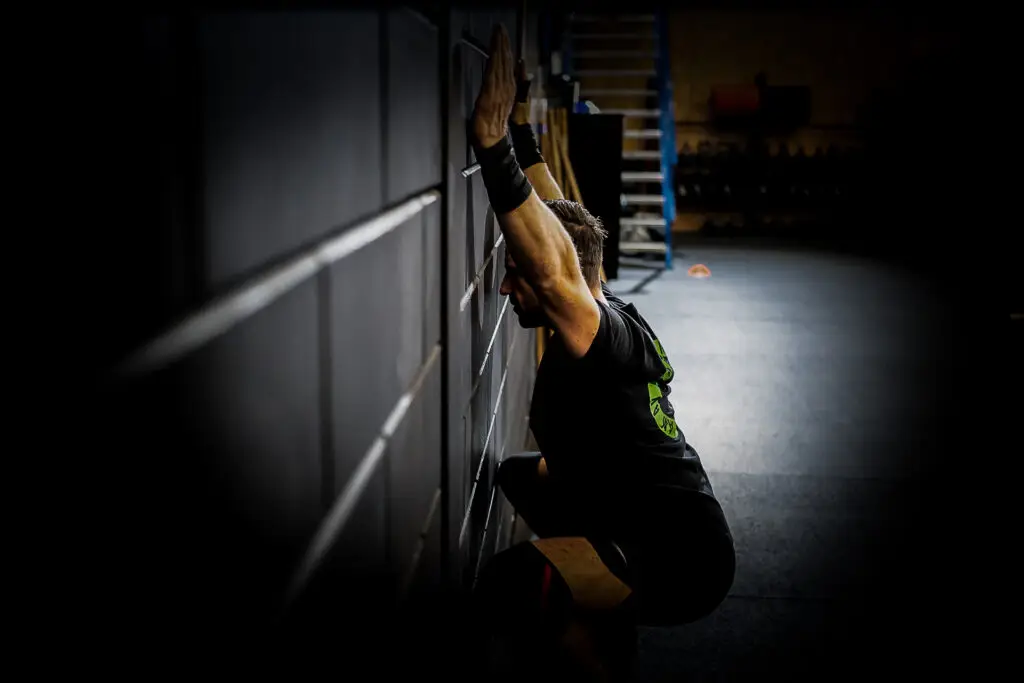
Is CrossFit injury prone?
Let’s start with the numbers. Multiple scientific studies show that CrossFit averages between 2 and 4 injuries per 1,000 hours of training. That’s in the same range as:
- Running
- Powerlifting
- Olympic weightlifting
- Team sports
So CrossFit is no more dangerous than other sports. What does emerge clearly from research:
- The biggest risk factor for an injury is a previous injury to the same tissue
- Inconsistent training increases risk
- Large training spikes increase risk
In other words: The problem is rarely the sport. The problem is how a person trains.
Why quitting training is often the worst idea
Many people with back or shoulder pain stop moving completely. That sounds logical. But physiologically, it’s often not smart. Muscles, tendons and connective tissue adapt to load. When you stop completely:
- Declines in taxability
- Becomes tissue less tolerant
- Does return actually become more difficult
Research on tendon adaptation shows that controlled loading is essential for recovery. Tendons like consistent stimuli, not months of doing nothing and then suddenly full load. Therefore, the question is not, “Should I quit CrossFit?” But, “How do we adjust it smartly? ” Read more about our box via this link.
CrossFitting with back pain
Back pain is the most frequently cited reason why people label CrossFit as dangerous. But low back pain does not automatically mean injury. In many cases (but not limited to) it involves:
- Overload
- Irritation
- Temporarily reduced load capacity
- Motion Sensitivity
What is important to understand: The load on the lower back increases as the trunk tilts forward and the external load increases. That doesn’t mean you should never deadlift again. It means you have to dose smartly.
Examples of adjustments for back pain:
- Sumo deadlift instead of conventional (more vertical torso)
- Hex bar deadlift
- Sumo Kettlebell deadlift
- Goblet squat instead of back squat
- Front squat instead of low-bar back squat
- Less weight, more control
- Strict pull-ups instead of kipping for extension intolerance
We maintain the training goal. We adjust the mechanical load. That’s professional coaching.
CrossFitting with shoulder problems
Shoulder problems are often caused (but not limited to) by:
- Starting kipping pull ups too early
- Previous shoulder injuries
- Overexertion (often due to rapid movements)
- Poor technique
- Inconsistent training
What many people don’t know: Most shoulder problems respond just fine to metered, progressive loading.
Complete rest often makes the shoulder more sensitive.
Smart adjustments for shoulder pain:
- Dumbbells instead of barbell (more freedom of movement)
- Ring rows instead of pull ups
- Push-ups on elevation
- Limiting irritating range of motion
- More emphasis on controlled eccentric phases
- Lighter weights with more focus on stability improve
Important: Pain is not automatically damage. But increasing pain, swelling or loss of strength should be taken seriously.
When should you not continue training?
There are situations where you should not keep adapting and scale up to a specialist:
- Stress fractures
- Neurological complaints (aura, loss of strength)
- Increasing pain despite load management
- Swelling or instability
- Acute traumas
In these cases, cooperation with a specialist is necessary. That’s why we feel it’s important to have short lines of communication with a physical therapist who has experience with athletes and strength training. Not every physical therapist understands complex movements like snatches, kipping pull-ups or heavy deadlifts. That’s why we are so happy to have our own in-house physical therapist Luuk Lemmens.
Crossfitting with injury at crossfit ede - valley
Did you:
- Back pain and in doubt about starting?
- Shoulder pain and worried it might get worse?
- An old injury and don’t know if it’s wise?
Then the last thing you should do is sit at home.
Feel more than free to contact us or request a trial class at this link.
We look together:
- What is possible
- How we adjust the tax
- Whether physical therapy is needed in Ede
- How you can start safely
You don’t have to be 100% pain-free to start. You just need to be properly guided.
Send us a WhatsApp and briefly tell us what your complaint is. Then we will look at the possibilities together.
Source
- Weisenthal BM et al. Injury rate and patterns among CrossFit athletes. Orthop J Sports Med. 2014.
- Klimek C et al. Are injuries more common with CrossFit training? J Strength Cond Res. 2018.
- Mehrab M et al. Injury incidence and patterns in CrossFit athletes. BMJ Open Sport Exerc Med. 2017.
- Gabbett TJ. The training-injury prevention paradox. Br J Sports Med. 2016.
- Magnusson SP et al. Tendon adaptation to loading. J Appl Physiol. 2010.
- Malliaras P et al. Patellar tendinopathy: clinical management. Br J Sports Med. 2015.
- Littlewood C et al. Exercise therapy for rotator cuff tendinopathy. Br J Sports Med. 2013.